Showing posts with label ukraine. Show all posts

Thursday, April 8, 2010

Ode to Odessa

Unfortunately I didn’t get much more sleep and we rolled into Odessa fairly early in the AM.  I was tired, disoriented, hungry, and this combination is never good in decision-making situations.  I ended up talking to an old woman offering rooms.  I asked where.  She said, “Just behind the station.”  A 30 minute tram ride, and a 10 minute walk down a dirt road later, we were halfway to Kiev and very much out of the centre.  I was to stay in a house owned by a woman named Nadezhda (which means ‘Hope’ in Russian), a great ogress of a woman, billowy and dolled up in pink lipstick and a hairstyle and colour that reflected the chic and cosmopolitan nature of the Odessa populace in the late 70s—early 80s.  Evidently the woman at the station played agent to people like Nadezhda (Naddie, as I like to remember her as) and collected a small fee.  

Naddie was by no means a warm and welcoming hostess, and I was not totally pleased with the location, but was at the point where I did not have a great deal of choice.  Not feeling totally comfortable staying there for any amount of time, but also realising that being tired was no excuse or being grumpy, I went out to take in all that Odessa had to offer, which involved falling asleep on a cement dock several kilometers south of Odessa proper.

I bounced around from café to café in Odessa's bohemian quater and one customer could tell I was an English speaker.  As it turned out he had lived in Kitimat working on the oil pipeline, or oil terminal, or a boat that regularly called at Kitimat and carried oil.  His name was Alexei and he invited me to his house for a barbecue the next day, and even offered to put me up for the night.  This was a nice alternative to the outskirts of Odessa with Naddie and her pony-sized angry dog.  So I kicked around the city, bought some vintage postcards, went to the famed Potemkin Steps and looked for the nearest baby carriage to push down them, and ate a nice dinner at a Georgian restaurant that involved an awkward toilet-not-working situation and three women barging in on me in the bathroom.  Lots of fun. 

It was just as well too.  I returned just after 9pm and boy did Naddie let me have it.  It was past my curfew and she was not pleased.  She was also not pleased with my inability to speak perfect Russian (or Russian at all, really.  I was not very good at this stage in my trip, and I get progressively worse—possibly on purpose—when dealing with people I don’t like).   She had soup ready for me, which was nice, but was not happy I had let it go cold.  The next day, I collected myself and said goodbye to the fair Nadezhda for the last time—until I saw her again when I was waiting for the tram.  But since then we haven’t bumped into each other.  

I found Alexei’s home and met his family.  He was Ukrainian and his wife was from Volga German descent.  The grandmother lived with them and while she looked as Ukrainian as can be, she still spoke German.  We had a barbecue and Alexei told me about life in the Ukrainian army, which involved times in which he had to crawl through mud, eat worms, and drink urine.  This, coupled with the memory of an article in National Geographic I read about Ukraine in the mid 90s that had pictures of Ukrainians lifting weights by means of a makeshift gym constructed from dismantled Soviet tanks has led me to conclude that if push had ever come to shove, we would have lost the Cold War big time. 

A Meek Layover in Mikolaev

After waking up and showering in some sort of adjoining shed with cold water and a door that didn't lock which opened into the common room of the neighbour's house (I have no idea where the women who rented to me slept) I decided that the time to leave Crimea was upon me.  I had been there for close to a week and I needed to move on with my life.  The perfect way to get over Crimea was to go to Mikolaev.  It makes perfect sense to, because from what I had read it was a shipbuilding centre in the Soviet Union and was rumoured to have a very industrial landscape.  The only train left in the evening and the ticket was somewhere around $7 in third class.  Everyone had a great time making fun of me for patching my jeans with needle and thread and for being foreign in general.  The conductress was a formidable, no-nonsense old girl who ran a tight ship but could also show kindness and good cheer when deemed appropriate.  When the train docked at Mikolaev at 3am and I sleepily dragged my carcass off the train and into the train station to see what my options were, I was unpleasantly surprised.

I actually wasn't surprised at all.  Who has even heard of Mikolaev?  Why did I think it was a good idea to go here?  There was nowhere to sleep, it was 3am, and the only train out was at 3:300--the train I had just arrived on.  In the half hour gap that the train was stopped, I had to make some serious life decisions.  As I reboarded the train after purchasing a ticket from Mikolaev to Odessa, and handing it to the same conductress who bellowed with laughter, I matter-of-factly explained to her that as soon as I arrived, I realised this is not where I want to be.  Not in Mikolaev.  Not at 24.  Not at 3am.  Just not now.  Maybe some other time, but this was about me, my happiness.  I wanted to be in Odessa.  She shrugged and showed me to the same bed I had used before, laughing the whole way.  In the end, I got a fresh pair of sheets in the middle of the night, a dishtowel that I was able to keep, and I got to experience the joy and laughter of a stern Ukrainian conductress.  In all, a complete victory for me.

Wednesday, April 7, 2010

An Expat in Evpat

I was hoping to see more of the Crimea than simply Yalta, a morning in Sevastapol and the historic and culturally relevant Turkish bazaar of Sim City, I dispatched messages to the farthest reaches of the autonomous republic in hopes of securing information on a place to sleep and a bit of local information about the towns.  Of course, I was determined to take in all of the peninsula that the Rosa Review recommended to me, namely Balachersai, the old Khan’s palace.  A young lady, identifying heavily as Christian and selecting “Female only” under gender preferences on Couchsurfing did not respond.  Not willing to let gender and religious oppression get me down, I tried farther east to Kerch, a ferry crossing guarding the mouth of the Sea of Azov and facing Russia’s Black Sea coast.  

Kerch had dubious claims of a youth hostel, and while I was more than willing to go there and take my chances on the ladies at the train station, what I wasn’t willing to do was sleep outside at this point.  Don’t make the foolish mistake of inferring from this that I think I am somehow above sleeping outside, but I was down to a thin cotton spring jacket and a windbreaker not designed to break the particularly arctic winds sweeping in from across the Black Sea, or the particularly arctic northwesterlies gathering steam in the Urals and Steppes to last one night outside.  That and I had also become a bit more self aware in Crimea about how much of a tourist I looked, and how easily things could be stolen from me if I was sprawled out and snoring on a park bench.  Oh! And being arrested for sleeping outside, of course.  And then subsequently robbed by the police.

The only response I did receive from Couchsurfing was from Maksym in Evpatoria.  Even Kevin and Shelly in Simferopol didn’t respond! (not Kevin and Shelly! you gasp).  I took the $1 wooded-seated, electric train to Evpatoria, a resort town of sorts on the Crimean west coast, and then a small commuter bus to the the village of Shtormove.  In the marshrutka, I asked a sturdy soldieress to borrow her phone and let me know when we reached the turnoff for the village.  As soon as we passed the turnoff she shrieked in Russian, “STOP THIS MARSHRUTKA NOW!” and then everyone else started screaming to stop and the driver slammed on the brakes to let me and my 20kg MEC backpack gingerly tetris myself out from the backseat, over luggage, apologising profusely on the way and hoping enough thank-yous and impish smiles would ease the situation and melt the ice that had recently frosted over everyone’s patience.  It didn’t, so I tipped the driver and disembarked.  Happy to be rid of me and my baggage, the driver sped off and left me in a cloud of dust. 
Maksym’s family took to me right away.  The mother was Russian and revelled in the joys of feeding famished young men.  The father was a pleasant and friendly man of Ukrainian stock, and had been vice-president of the local khokoz during the Soviet era.  I was staying in the house of a former mid-level Soviet bureaucrat.  This was my dream.  This was me living out my dream.  A well-respected man in the community, he had eased his way out of the political economy in the early 90s due to various conflicts with his former colleagues.   

On a walk around the village, Maksym took me to his former elementary school where we stopped in on an English class.  The young teacher was not pleased to have us show up unexpected, but when her cell phone rang, she had no qualms with leaving the classroom in our charge for 30 minute while she went outside to talk.  Then the director came and told us we were not welcome.  Maksym explained an equally curious reasoning for this curiousity—the young teachers were rigid and unenthusiastic, whereas the older teachers were full of energy, fun, and revelled in the joys of teaching and seeing their former pupils.  The rest of the village, which contained an abandoned palace of culture and many socialist realist murals, as well as playgrounds and parks in disrepair, helped to illustrate his points about how the collapse of the Soviet Union had meant the subsequent collapse of community.  There was no money for cultural programs or community events and people were much more interested in the pursuit of money at their neighbour’s expense.  Having been only four years old when the SU called it a day and coming from a well-to-do family, Maksym represented an interesting viewpoint for his generation.

Then we visited babushka.  She lived in a khrushchoba across from the school and was soaking her feet and watching soaps in her housecoat when we showed up.    She immediately embraced me into her bosom and planted a big kiss on my cheek, calling me Sacha outright*, though not before asking if we were hungry.  Not waiting for an answer, she went to the kitchen muttering about how in Canada, we think that they don’t eat in the Ukraine, but she will show me how Ukrainians really eat.  Terrified of not being able to handle the onslaught to be proffered, I braced myself for the onslaught: soup, salo (slices of cured lard with raw garlic on bread and spring onion), stewed meat suspended in jelly**, salami, radishes, and much more.  A man also came in who I understood to be Maksym’s uncle.  He asked about Canada, specifically the cost of living (i.e. the price of vodka and cigarettes).  After destroying his streets-paved-with-gold image of Canada with the reality that it’s all paid for in sin tax, he renounced all desires to move there***.  After we left, I learned that this man was in fact babushka’s new husband—15+ years her junior.  Maksym shrugged it off with a smile and said, “She likes the younger men.”  Good for her.  That’s the kind of can-do attitude I like to see in today’s elderly. 

*I’m sure you know will have deduced that Sacha is the hypocoristic of Alexander, which often drifts—and no exception in my case—into the diminutive Sashenka.  Further variations include Sanya, Shaska, Shashechka, Shurik, Shura, Shurka and Shurochka—all well-known to me. I learned long ago that “Rory” is not user-friendly anywhere outside the Anglosphere, and have consequently opted towards my middle name. 

** I don’t know what the name of this is and while it’s only a Google search away, I am leaving it as-is because it helps to illustrate a point I recently made about English not being particularly creative with culinary naming and our choice to simply adopt and anglicise foreign names for foods help to disguise the fact that we’re dealing with stewed meat suspended in jelly

*** My sincerest apologies to the late Clifford Sifton and his descendents.  I, in no way, was consciously trying to undo his proud legacy of attracting Ukrainians to Canada.

Tuesday, April 6, 2010

SimCity 2000

Something that you perhaps do not know or have not heard in passing is that Stalin was a fan of relocation programs.  He simply lived for them.   Give him fifty or so ethnic clusters and 1/6th of the globe and he would spend hours--decades, even--mixing and matching and having a great time.  Easy to please.  The Ottoman Turks, on the other hand, loved setting up bazaars in other countries and leaving them as a lasting legacy.

Of course, Google Maps has not taken this into account.  Google Maps and I have been playing quite the chess match of wits, these past few years, and we're always trying to foil one and other.  My thoughts were that preparations for Simferopol need only a quick Google Mapping to determine the distance from the train station to the centre.  So when I saw the swirling streets on Google Maps that anyone who has spent at least three weeks in Tunisia and is therefore an expert on Ottoman-Arabesque urban planning would know is a bazaar/souk and that it would be bustling with activity, I figured I knew exactly where to go and would not entertain any other possibilities.

Crimea was, afterall, the centre of the Crimean Tatars and Simferopol its capital.  Some postcards I bought in Yalta showed Simferopol in the 17th and 18th century as a bustling centre of commerce done in rich Oriental styles.  I assumed absolutely nothing had changed.  And who doesn't love Turkish bazaars outside of Turkey?  I was excited to see how the Russians had incorporated this into their retailing geography.  Sarajevo had capitalised on it as the focal point for tourists, offering decendent and exotic experience to self-proclaimed Orientalists;  Skopje used its bazaar for everyday purpose, presumably the same cottage industries operating out of each shop as for the past several hundred years.  So what, I was curious to know, would it be like when you fill a Turkish bazaar with Russians?  The answer was surprisingly simple and immensely disappointing.

Simferopol's bazaar was, as noted, a Turkish bazaar filled with Russians.  Russians who did not care about the Tatar legacy, and Russians who were relocated there during the era of centrally-planned economies.  As such, the winding streets were not lined with shops and merchants and cafes.  They were barren, desolate, and closed off.  The entire area was residental now, and there was only one or two Soviet-era kiosks selling just the barest of essentials like bread, chocolate, cigarettes and vodka.  Stalin had won.

Sim City Trans seemed well-
financed, but the historic quarter
could have used some
porntipsguzzardo (plus
a few additional 'ardo' entries).
Most of where Simferopol is bumpin' is on the gridded and ordered Pushkin Street, just outside the bazaar. (It's a good chance that anywhere in the FSU will have the centre of its activity around something called "Pushkin Street" which adjoins to some sort of park named after Taras Shevchenko)  And nothing makes a town in the Ukraine bump harder than dark and sketchy-looking "Internet Clubs" which exist for the sole purpose of online gambling.  These, of course, lined the main street.  In addition there was a statue of Lenin, the administrative building for the Crimean Autonomous Republic, and hospital that had absolutely nothing to do with Florence Nightingale. 

I found one Tatar restaurant where I enjoyed a dish of Plov (a pilaf of sorts) with a Turkish coffee and then I looked around for acceptable pizza.  Determining that it was not to be had, I opted, finally, to get a haircut.  I selected from a large poster on the wall the least 80s  haircut available and had to wait for the barber to stop making out with his girlfriend in front of me before he began cutting my hair.  I used this opportunity to figure out how to explain to him that I did not want a rattail, even if it looked apropos on him.

Night fell and I became increasingly unsure about my plans.  Was I to head to Kerch?  Evpatoria?  Was I to leave the Crimea for good?  Mulling this over a beer and some perogies at a Ukrainian beer parlour next to the station, I was quickly swayed by one of the old women outside offering rooms.  I shrewdly negotiated a room with an old Tatar and she even threw in some free tea.  This bought me some time and I was able to plan my next move, getting out of Crimea.

Thursday, April 1, 2010

Ballin' in B-Clav

No Flo Zone.
 The first disappointment about Balaclava is that I could not find a single statue of Florence Nightingale.  This is something I have since had to get used to: there are a lot of statues in Ukraine, and almost none of them are of Flo-Night.  I suppose a lot of this makes sense because she was on the opposing side of the Russians, and they tend to play up their efforts instead (for more on this, see every single monument ever built in the Ex-USSR which shows the struggles endured during the Great Patriotic War).  The second disappointment is that is was almost impossible to find the hostel, and that it wasn’t really a hostel, and that it wasn’t really in Balaclava.  This is something I had to come to terms with as well.  The third thing I wasn’t totally keen on was that there were no perogies to be had in the Crimean peninsula, and this is something I grade very harshly on when taking Slavic countries into account.
   
The Port of Balaclava, featuring
New Money.
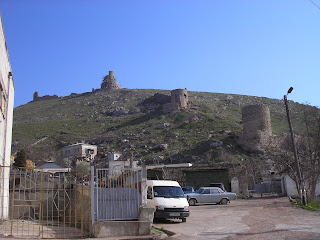
 As it would turn out, the Crimean Tatars have been making a comeback and their food is increasingly prevalent.  The problem is that there is a fairly large racial divide between the Russians, Ukrainians and Tatars, and asking for perogies in a Tatar restaurant results in a scowl, pilaf in a Ukrainian restaurant gets a scowl and anything that isn’t Russian in a Russian restaurant a nasty scowl and a lecture on why anything else is not good for you except meat-filled pelmeni with sour cream.  Despite having a wealth of fortresses and interesting landmarks, the Ukrainians have left much of the area to fallow, so children are free to walk up to crumbling fortresses built by the Genovese (I have no idea what the Genovese were doing here.  Presumably not introducing a café culture, that is all I have been able to ascertain) and Turks (same argument as with the Genovese).  I walked up to the fortress on the cliff to survey my most recent conquest, and was able to confirm that the Black Sea is quite large.  You heard it here first.

Balaclava was by no means a disappointment, but there was something a bit lacking in it.  The cherry blossoms were blooming and it was certainly a beautiful time to be there, but the inner harbour suffered from neglect.  As it was my birthday, I decided the only want to truly turn 24 (and this goes for everyone) is to do it in Yalta.  So back to Sevastapol I sheepishly crawled and into a marshrutka that dropped me off in Yalta, the resort capital of the Soviet Union and the place where eastern Europe was carved and served upon a platter like a ham nugget.   


A pressure front.


Fortifications.
  

This old girl has the right idea.
 
Putting pictures up in Blogger is the bane of my existence.

Crimea River

Such were my material circumstances en route to the Crimea.
Tea, yogurt, and hard-boiled eggs.  Jealous?
The first thing I actually wanted to do when I arrived in the Crimea was cry. I just wanted to sit down and cry my little heart out until I couldn’t feel pain anymore. There are several reasons for this: for one, I had just spent 18 hours on a train; second, I learned the hard way that you do NOT, under any circumstances, try to steal a towel from Ukrainian State Railways; third, I had no idea how to get to the centre of town because Sevastapol has a very confusing urban geography, and when I tried asking a marshrutka driver who had stopped to pick up a large group of people he started screaming at me and then flipped me the bird. 

As you can imagine, this was really, really upsetting for me. Apparently in The Orient (defined in my geographic imagination as anywhere outside the Pacific coast of Canada) it’s quite commonplace to yell and flip the bird, but I am Canadian and this is completely unacceptable. I was so horrified that someone would do that to me that I sat and, as usual, considered writing a strongly-worded letter to the Sevastapol transit authority, assuming that these marshrutki are regulated and not anyone with a van can just start one up. 

Quarries!
Actually, as it would appear, literally anyone with a van can start up a marshrutka business. This is something quite foreign to me. In the Ukraine they are a bit more regulated than the furgon trade in Albania, with signs and defined stopping points, but if you can get your greasy little hands on an old Mercedes van and can weld some iron bars together in the back to make seats, then you are in business.  

Disembarkation proved to be
disorienting and emotionally
difficult.
Naturally, I have thought about transplanting this brilliant system back into the heart of pro-environment and public transit Canada, Vancouver. Imagine, if you will,: 1) a number of old Mercedes vans crowding the UBC bus loop with several fat old men with a shirt rolled up to their armpits screaming the destination and then herding students into their respective vehicles; or 2) a 7-year-old kid hanging out of a van circling Westbrook Mall screaming the destination and having it stop every time a student flags it down. Groups of hipsters would flock to the Main Street-Commerical Drive marshrukta, rich kids would abandon their BMWs and Mercedes Benzes for the sleek and rugged look of a 1985 orange Mercedes delivery van, and all those women who collect bottles at UBC would be delighted by the roofracks when they are taking the day’s haul back to Shaughnessy.

Until all this catches on, however, I’ll have to stay in eastern Europe to really maximize my love, and utter contempt, for affordable public transit. So feeling sorry for myself was not in the cards—this was life. If being treated poorly by a Ukrainian was a part of growing up, then I was going to do it. As usual, I rationalised that I would hate driving a marshrutka and having to deal with someone like me.  So I sat at the bus stop and talked with an old woman who confessed that English is the international language, but that she refused to learn it.  I told her she had gotten this far already and that I agree—it's not worth it.  

These three had an easier time
navigating the peninsula, I'm told.
When I had purchased my ticket to Sevastapol, I wasn’t really thinking about where I would go. I assumed the Crimea was enough of a destination and so I just blindly went. As such, I had no plan or idea of where I would stay in Sevastapol and was devastated to disembark and find nowhere to stay. I was still new to the scene and I was not expecting hoards of babas to swarm me at the station with cardboard sheets pinned to their jackets offering rooms. When they did I was immediately wary of their mysterious and pixieish ways, and I decided to stay clear of these Crimean sirens and opt for a café with wifi instead, where I discovered some form of lodging/hostel in Balaclava. Naturally, this was exactly where I wanted to go: I love the Crimean War, I love the Charge of the Light Brigade, and I love the fierce rivalry between Florence Nightingale and Mary Seacole. All of this took place 150 prior in the little inlet of Balaclava, famous the world over for the aforementioned things and the namesake for appropriate ski-wear in Canada and a street in Vancouver that several of my friends have lived on.
 
So I bid adieu to the fair Sevastapol and my cool and hate-filled memories associated with it, and decided that I would spend my pre-birthday in Balaclava, reliving as much as I could of the great battles between the Turks and the Russians, and figuring out how to get to Yalta.

Tuesday, March 30, 2010

DP World

One of the biggest problems facing me in the Ukraine is that I gave my jacket to my dad to take back with him to Canada. I assumed that by the end of March it would be warm enough for me to only need my spring jacket, and that summer would be upon us soon enough. This wasn’t such a naïve thought, too, because only months later structurally-sound young Muscovites were taking to the streets in bikinis and high-heeled shoes to beat the heat. With this in mind, and in spite of the icy winds through the streets of Kiev, I had pushed on to Kharkov, but decided to take a sharp right-hand turn to the south and the Crimean resorts on the balmy Black Sea. Not, however, before making a pit stop in Dnipropetrovs’k, partly because I wanted to break up a 20+ hour train ride, and partly because I had a hard time pronouncing the name and that intrigued me.

DP, as I like to call it, is a place that certainly almost never comes to mind when people think about the Ukraine, and probably wouldn’t even come to mind when one gets together with friends to play a rousing game of listing the most populous cities in the Ukraine. This is a mistake, because evidently it’s number 3. So why is this place so shrouded in mystery and anonymity? Partly the name is so confusing that no one attempts to pronounce or remember it. Part of it is because, believe it or not, many people don’t actually care about the Ukraine and spend hours poring over maps of it. But the real reason is because during the Soviet era it was a “secret city.” DP is famous throughout Ukraine and the former Soviet Union as the main production centre for nuclear weapons and spaceship components, but it was purposely left off the maps as though it did not exist. Until recently, on the highways leading up the city there were no indicators that a city of 2 million people was there until lo and behold a massive industrial giant materialised out of nowhere.

But for all its industrial and warfare-oriented pretensions, it’s actually quite a beautiful city. There Because of the large dam on the Dniepr to the south at Zaporizhe, the city is surrounded by [oily, chemical-laden] water and there are lush parks and a river walk all along the water front. Karl Marx Avenue runs straight through the town, flanking a large promenade and boulevard where a craft market has set up shop. In fact, say what you will about the Ukrainian oligarchy and their scheming and corruption, but they have made considerable efforts to up the game of their respective cities vis-à-vis the historical and European appeal of Western Ukraine and the political cachet of Kiev. There is nothing I like more than boorish coal and steel barons flexing their economic muscle and building opera houses in factory towns.

Evidently, however, DP’s success and rejuvenation hasn’t been purely due to the recent success of its industrial elites. As is well-known to any economic historian who has studied the collapse of the Soviet Union intimately, the concentration of military and industrial capital in Dnipropetrovs’k sired an elite who ruled the Soviet Union for much of its later years. The most famous scion, Leonid Brezhnev[‘s eyebrows], was groomed by the Dnipropetrovs’k Chateau Clique for an iron-fisted and in the end bumbling and almost incoherent 18-year rule of the Soviet Union. To my delight, my CouchSurfing hosts took me to a bar which featured celebrity shots of Brezhnev himself. You’ll also remember the Ukrainian Princess Leia, political super-babe Yulia Timoshenko is also from DP, and despite her Ukrainian name and her allegedly-pro-Western-lesser-of-two-evils approach to politics, she only learned the Ukrainian language in her later years and has intimate ties to the Russian state. She is a living example that with the right ties and hair style, anyone from DP can go from managing and later privatising a student-run video rental store to owning a massive steel and chemical conglomerate, and inevitably end up in jail on corruption charges. What fertile grounds for success and ultimately devastating failure! I wouldn’t have it any other way.

You may well ask what I actually did while in DP. Well, not a great deal. I was impressed by some of the architecture—evidently it had been a very small, old town and the centre preserved some of the shells of buildings that sustained heavy enough tank damage to render them useless, but not be torn down or replaced. I also enjoyed the parks, the $2 “Biznez Lanch” specials, a night of bowling (I had no idea 10-pin bowling existed—what a cultural shock! Ukraine taught me so much about myself), and the 6-stop metro that runs from the train station out to the factory districts in the outskirts, and I was fortunate enough to have my host, an American English teacher, take me on a metro station pub crawl, one that thankfully didn’t result in my getting beaten and left for dead in the suburbs. Owing almost entirely to this, I can count my time in DP as a success and recommend it to all.*


*One thing to note is that I am currently engaged in a minor impasse with the Ukrainian Postal Service. I sent three or four large packages of post cards from the central post office in Dnipropetrovs’k and I dropped them off in the post box outside, as directed. They have never arrived and I am starting to suspect that the box I dropped them into was merely a decorative feature. So if you’re going to DP, can you please ask at the post office to look in that box and see if my parcels are still in there? I would really, really appreciate it. I’m also considering writing a strongly-worded letter to their public relations department and that’s bound to go straight to the top, so it’s not a problem if you aren’t in the neighbourhood.

Saturday, March 27, 2010

Harking on Kharkov

Look at these attractive,
young Ukrainians!
While Kiev may be the political heart of Ukraine, and the west the cultural heart, there were still vast tracts of land left to cover before I could justifiably claim that I had “done” the Ukraine. Of course, I’m talking about the industrial heartland east of the great ribbon of commerce/toxicity the Dniepr River. The secret to any Russian Imperial, Soviet, and subsequent Ukrainian success has always lain in the rich coal seams of the Donbass and the enterprising, hardy spirit of the Steppes-peoples. Mammoth planned communities of equally gargantuan industrial capacity were thickly spread before me with such tantalizing and alluring names like Dnipropetrovs’k, Donetsk and Zaporizhe and Kryvyi Rih—well-known to any aspiring steel magnate. But before I was able to eagerly pounce, I had my heart and sights first set on the nerve centre of this industrial magnate, Kharkov.

Actually, it was just as much a surprise to me as it no doubt is to you that it is no longer called Kharkov, but Kharkiv. This is a name change I refuse to ratify for various reasons. First of all, why are cities changing their names? I have never accepted the legitimacy of Mumbai over Bombay, Istanbul over Constantinople and I am certainly not about to make concessions for Jakarta over the much more illustrious Batavia. While I’ve been known to be torn over whether or not to refer to the capital of the Slovak Republic as Pressburg, Pozsony, or Istropolis, I cannot in good conscious worry about minor changes such as an ‘o’ to an ‘i.’ The second reason for objection, of course, is the most important and Civ II enthusiasts the world over will bellow a chorus of assent: when you play as the Russians, the name is Kharkov. Until Sid Meier retroactively releases an updated version of Civilization II with a special note alerting us to these apparently sensitive and politically-motivated name changes, I will continue to use the 1996 edition as my benchmark gold standard in history, geography and diplomacy.

Fun facts about Kharkov that you’re free to share with your friends at dinner parties: 
  1. It’s the second largest city in the Ukraine.
  2. It has the largest 6th largest public square in the world Europe.
  3. It was almost entirely rebuilt after the Second World War because whatever the Germans didn’t destroy on their push through, the Soviets surely did on their push back, hoping to make a nice, blank slate for centrally-planned urban space.
  4. It’s really, really close to Russia. I could see Russia if I squinted.
I know, right—wow!  When I first saw this picture (in Wikipedia, obviously, which has been magnanimous in its supply of pictures) I thought “omfg I have to go there!"  But when you’re in the middle of this 119,000m2 mass of concrete in late March and the winds are blowing in from the Urals, it’s actually quite cold and disappointing. 
I was greeted in Karkov by Maksim, a young entrepreneur who was my couchsurfing host. He lived in a flat with his girlfriend Nastia, a journalist, with another couple, Igor and his girlfriend. Igor was a graphic designer specialising in Adobe Photoshop. I told him I played around with a bit of graphic design too. He showed me his work, which was amazing and clearly required what I think people mean by “skill” when they list it on their CVs. I was a bit bashful when he asked me to produce an example of my work, which can be seen here. 

You had better believe this was in a square named after Taras Shevchenko.
I was charged with the tall task of preparing dinner for everyone. For every guest they have, they ask them to cook a meal that no one there has ever eaten. I naturally thought of sushi, but evidently it’s the Ukraine’s most popular dish these days. They had never eaten Mexican and while as a Canadian I am no authority on Mexican cuisine and how to properly make it, lest we forget that Ukrainians have no idea about a Canadian’s capacity to accurately prepare Mexican food, and thus my secret was safe.
We went to the supermarket for supplies, and fasten a Mexican meal out of Ukrainian victuals. Highlights included:
  • Talking to an old man who asked why I was in Ukraine. I explained to him I liked the people, the history, and then a word which, to me, was “food” in Russian but ended up being a very unsavoury curse word in Ukrainian. Of course, with my bellowing and obvious Anglo-Saxon accent, the whole store heard me holler in their native tongue, “I LOVE UKRAINIAN _____” which sent them all—especially the old man—into convulsive peals of laughter and Nastia into a bright red orb of embarrassment.
  • Discovering that you can’t buy bags of ice in the Ukraine. For a people who I was under the impression invented ice, it seemed to be in short supply. After I stared at Maksym in disbelief he shook my shoulders and said, “I KNOW! We can’t buy ice! How do we live in Ukraine!?” We settled on the fish department and to assuage the concerns of the fishmonger Maksym explained, “It’s for an American”—the universal catch-all to account for strange behaviour.
  • Using shwarma wraps to make my own tortilla chips, and winning.
The old gang, back together again.
The surprise of the evening was that I wasn’t simply going to be cooking for the four of them, but in fact for a whole Cossack hoard—11 in total. Two were business colleagues from Russia, and other friends and relatives had showed up for the spicy fiesta. I enlisted the help of the younger brother and sister of Nastia by issuing imperatives such as “перемешайте!” (mix) and “сокращение!” (cut) after holding up different items to the obedient and extremely polite young sous-chefs. It was a fantastic success in every sense of the word. We had chicken fajitas, margaritas, tortillas and salsa and then we played mafia, which any former residence advisor is very familiar with. In all, a landslide success in Ostpolitik.

Wednesday, March 24, 2010

Keying into Kiev

Before leaving Chernivtsi we took a bus to Kamenets-Podolsky, which we later determined to be a sad and decaying town.  Unfortunately, we hadn’t read the Wikitravel entry on it, nor ran a quick Google Image search of it because it’s actually quite beautiful and historic.  Next time, I guess.  From Chernivtsi, we hopped aboard the night train to Kiev, which to my pleasant surprise was going to be 15 hours.  As I have come to learn, no matter where you want to go in Ukraine, it will take you 14+ hours by train.  That is because the trains travel at 40km/hour, but the good news is that they are always on time.  In each of the trains there is a schedule letting you know when we will arrive in each of the stopover cities, and for exactly how long.  What a dream job railway administration must have been for type-A personalities in the old system
Something I probably have never bothered to express via the medium of Web 2.0 blog postings is that I am really into metro systems in post-socialist countries.  Like, really into them.  It’s my dream to travel on, or at least gaze at from within, each one currently in existence.   Kiev’s metro gets a 6.  Out of 100.  But trying to figure out how to transfer at key spots is pretty tough, and don’t even think about taking a picture.  Unless, of course, you enjoy the idea of having five security guards suddenly emerge from inside the wall, surround you, and physically delete it from your camera.  God forbid I replicate this poorly-conceived public transit experiment anywhere in the first world.
Actually, I’m a bit hard on the Kiev metro.  I mean, it works, and it has some great reach, and it’s actually in the ground and there are trains.  That earns it more than Budapest’s Metro 4.  However, the painfully slow escalators that sometimes didn’t work (which left me stranded in Suburban Kiev because meaty-armed babushkas working for the transit authority would not let anyone into the station) have left it sitting pretty low on the list. 
We poked around Kiev, which has its share of churches and museums.   Naturally, of course, we had to stop by one of the hundreds of open air markets and blend in with the locals, in hopes of scoring free pickles and anything else the babas were vending.  We also saw the large motherland statue, affectionately known as “Tin Tits” in tourist brochures.  Say what you will about the inefficiencies of central planning, but when the necessity arises to procure enough sheet metal to build one of these in each of the republican capitals, it gets the job done.  And judging by this Slavic maiden’s piercing gaze and command of the landscape, it was well worth it. 
Kiev was lacking in something but it took me a while to really figure it out.  At first I thought it was an alternative, underground hipster scene, but I discovered all Po-So countries have those in spades and I was foolishly looking in the Podil neighbourhood, which was sadly did not live up to its 19th century reputation.  Then I thought perhaps it was the bars that were lacking, because from the outsider’s perspective the Kiev bar scene consists of kiosks on the street that sell “live” beer.  You bring your own plastic 1L bottle, they fill it up, and then you go join the hoards or people—homeless, students, businesspersons—in the park and drink it.  However, I discovered that there were plenty of suitable pubs that were simply disguised as other things, like a 1940s hospital/laboratory where you can drink shots out of test tubes and wear old German war helmets from the Great Patriotic War.

Just like West Edmonton Mall,
you can get Ukrainian food in Kiev.
I finally realised what it was that Kiev was missing: Ukrainians.  Aside from the Ukrainian flags and the enormous Hotel Ukraina in the centre of the town, there wasn’t a Ukrainian to be seen, except in “ethnic” restaurants peppered around the town.  Everyone spoke Russian, and the food was decidedly more bland than in the west.  The thing about the Ukraine is that all roads do not lead to Kiev.  For the most part, I don’t think all people in the Ukraine know that they live in a country called “Ukraine.”  If you’re from L’viv, then you’re a national hero and you are a true Ukrainian.  If you’re from anywhere east of Kiev, you’re probably a Russian and are unaware that a border exits between the two countries. 

Thursday, March 18, 2010

Booking into Bukovina

In my second year of university I purchased a copy of the Time-Life Library of Nations: the Soviet Union from a thrift store in Vancouver and I’ve never looked back.  I loved this book and read it often, marveling at the pictures of people operating large machines that consisting of knobs and buttons with presumably no function.  There was also a picture of two old ladies cleaning the boulevards of a major Soviet thoroughfare or highway.  It gave some sort of statistic about the number of roads in the SU being 1:10 as compared with the US despite having twice the land area and the same population.  

Well, all that is sort of immaterial when the majority of land in the SU is actually barren and unpopulated.  What isn’t barren and unpopulated, however, is the Ukraine and consequently I was expecting the best of Soviet infrastructure to greet me as I crossed into my first former Soviet republic.  The road existed, certainly, but was not particularly wide nor was it smooth.  This of course didn’t stop the driver from racing as fast as possible to make up for the lost time due to my passport at the border, being certain to hit every pothole he could while sporadically eyeing me in the rear-view mirror and giving me a big, wide steel-toothed smile and an enthusiastic thumbs up.

Perhaps you saw my brother act this
scene out in Russian class for a
school play in the early 90s.
Perhaps I’ve never expressed just how terrified I am of Ukrainian border control.  They wear full body camo suits that I feel are appropriate for Arctic missions on, combat boots, large fur hats, and a look of disdain and unwieldiness.  I am also terrified about lying on anything that is even remotely official, so when I had to tell the Ukrainians where I would be staying I naturally panicked.  The driver told me that I should list the “Hotel Bukovina” as my place of accommodation.  The border guard looked impressed, which terrified me more.  Why would an illustrious patron of the Hotel Bukovina be travelling by common coach?  Nevertheless, we were off.  

At the Chernivtsi avtovoksal, a crowd of two greeted me with a sign of my name in Cyrillic, as expected.   We then proceeded to our hotel—Hotel Bukovina.  I heaved an enormous sigh of relief that I would not be tracked down and thrown in a Ukrainian prison, or worse.  In retrospect, I had no idea why I would expect anything but the absolute best.  Here we were in Chernivtsi, one of the farthest outposts of the Austro-Hungarian Empire and the colonising and civilizing influences of the Viennese.*   This was still “Europe”—or something like it—and there was no reason not totake advantage of the exchange rate.

And what an exchange rate!  At the time the gryvnia to dollar ratio was 7.5:1 and while it usually means that things end up costing a similar price despite an exchange rate, this was not the case in the Ukraine.  Everything seemed to cost 1/7.5th the price of its equivalent in Canada.  Taxi rides, hotels, perogies, coffee, and it was all very high quality.  As it was St. Patrick’s Day, we went to a local pub for some beer and potato-based products.  Perogies of every filling filled our table: potato, cheese, mushroom, cabbage—the bounty of the harvest all rolled into neat little pockets and drenched in sour cream.  

After much merrymaking we got down to business to decide our plan of attack for the region.  We hired a taxi to take us to the town of Potochyshche (Поточище), where my great-grandmother was born.  Like most young girls at the time, she dreamed of city life and not marrying a local boy from the village.  I assume.  Actually, I have no idea what would make someone leave, but somewhere along the line the idea of leaving family and the only world you have known is outweighed by the possibility of immeasurable future returns.  This pioneering spirit, of course, might be responsible for the same attitude many North Americans share today vis-à-vis Europeans that when a child turns 18, they are out.  So, like many at the end of the 19th and beginning of the 20th century, she saw a sign advertising free land in Canada and decided that she, a single, 22-year-old Ruthenian debutante, was ready to take on the world.
  
While I have been praised far and wide for my Russian skills, one variable oft forgotten is that until March 18, 2010, I had never actually seen a real Russian person, much less a Ukrainian.  So when we entered the town hall of Potochyshche and demanded that they haul out every record they possessed in hopes of finding out where the remaining 16 or so brothers and sisters of my great-baba were today, I was hopelessly inadequate.  Of course, the documents they had were hopelessly inadequate as well.  They had no record of any of our family in the city—despite the town clerk having the same last name, but flat out refusing to entertain the possibility of being related to usand in a panic they called the oldest man in the village to verify.  In about 5 minutes he stormed in and began a rant the gist of which my many years of studying Russian definitely paid off for: the Soviets came.  Essentially, the Soviets came in and took the records, the people, and did whatever altering of the landscape was necessary in their vision of a glorious socialist future.

Of course, to be fair to the Soviets, they weren’t the only cause of upheaval in eastern Galicia and Bukovina.  Between 1918 and 1991 the region fell under roughly six flags—Austro-Hungarian, Ukrainian, Polish, Romanian, German, Soviet, and Ukrainian again—not to mention the many short lived republics that popped up in the chaos surrounding the end of WWI and the vacuum left by the collapse of the old imperial system.  Not that the majority of the villagers in the area particularly cared about these geopolitical manoeuvrings, rather just expressed annoyance at the constant stream of armies across their incredibly flat and arable land.  Nevertheless, after an hour or so, we could claim that we “did” Potochyshche and were on our way back. 

*Chernivtsi and Lviv were Austro-Hungarian bastions of culture and Ukrainianness on the Galician-Bukowinian steppes.  In fact the national awakenings of the 19th century occurred in these cities and, as in Prague, Budapest, Sarajevo, Zagreb, Ljubljana, Kosice and Krakow, all on the back of the firmly established and uniform Austrian education system and communication network.  My own grandmother presumably made it all the way to central Canada via Hamburg using the German she would have learned in school.  "And what have the Romans done for us?" indeed.